

A lacklustre recovery in European air traffic
10 July 2020 · 5 min read
Airlines must restructure: the cases of Air France and Lufthansa
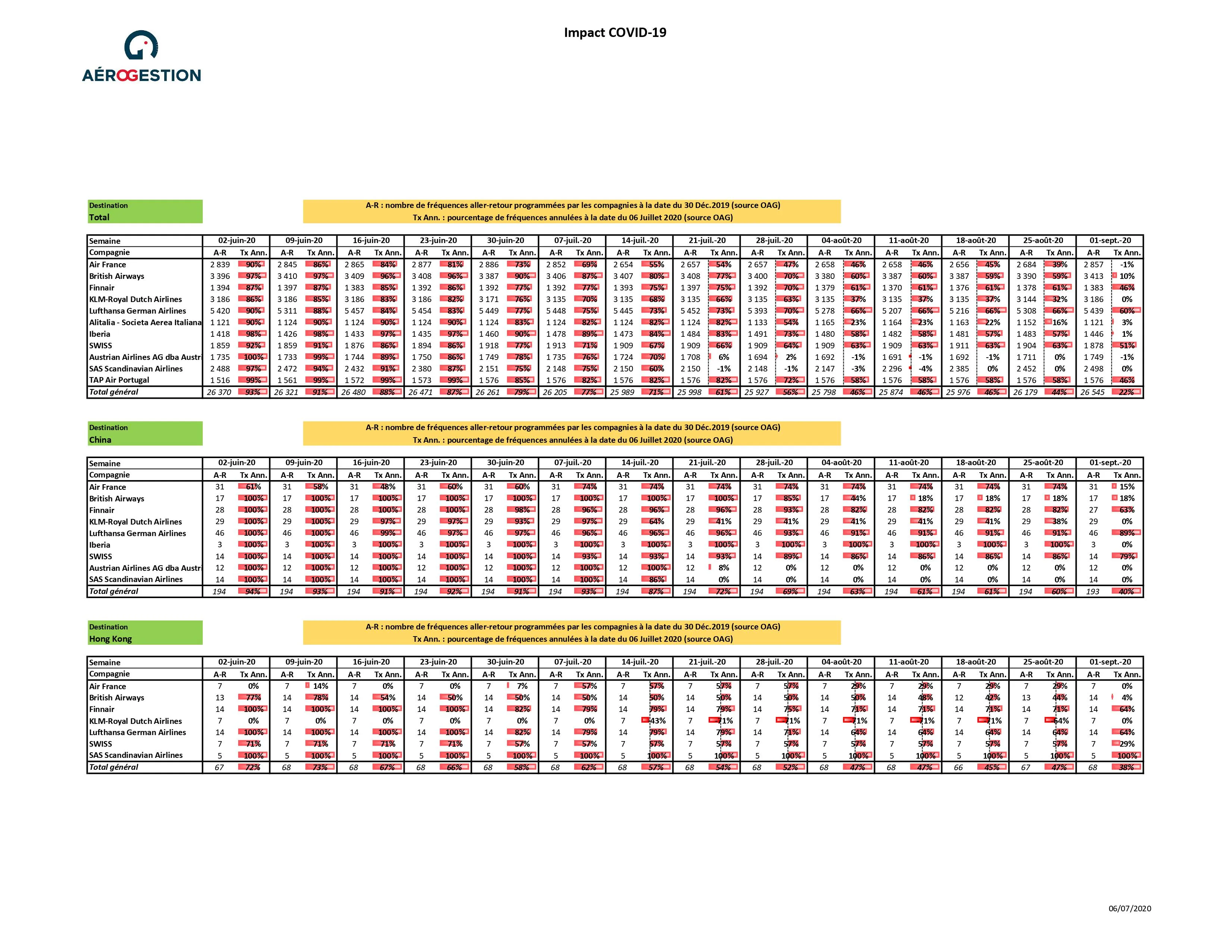
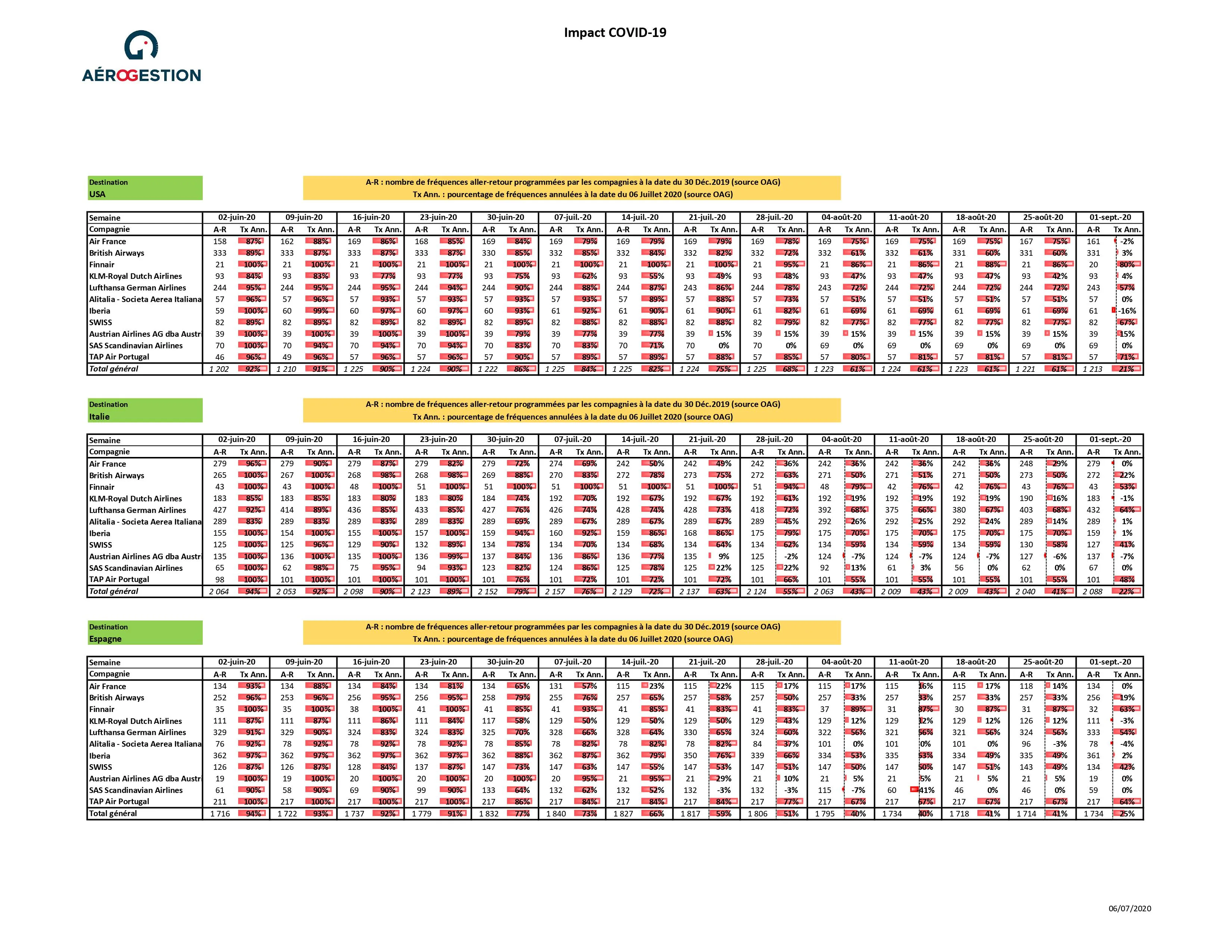
The recovery of air traffic began in June 2020 on a very gradual and modest basis: 93% of flights cancelled among our panel of European airlines in the 1st week of June, and still 87% in the 4th week.
The recovery trend is gathering pace in early July:
- As of 6 July 2020 (source: OAG, “Official Aviation Guide of the Airways”), 23% of European airlines’ international capacity [1] is being operated in the week of 7 to 13 July 2020, compared with the flight schedules drawn up by the airlines before the Covid-19 pandemic (end of December 2019).
That is 10 points better than the 4th week of June:
- Intra-European destinations in the south of Europe are regaining some vigour, with Spain and Italy, where the rate of cancelled flights has “fallen” to 73% and 76% respectively.
But the long-haul market is still sluggish:
16% of scheduled flights to the United States are operated, and only 7% to China.
The recent decision by Europe – at the end of June – not to reopen its external borders from 1st July to the United States, Russia and Turkey will keep long-haul capacity scarce.
Opening Europe to China and its tourists is subject to reciprocity, which looks unlikely to be obtained diplomatically in the short term.
Restructuring is unavoidable
Faced with this unprecedented situation, airlines are inevitably being led to undertake profound change.
“2020, annus horribilis”
- Abysmal losses of 23 billion euros in 2020 for the European airline sector (according to IATA, the International Air Transport Association)
- European GDP revised down to -8.3% by the European Commission (from -7.4% previously) and 30 million jobs lost in the OECD in 2020.
- UNCTAD (United Nations Conference on Trade and Development) estimates – in its intermediate scenario – that an eight-month interruption of international tourism would cause a shortfall of 2,200 billion dollars for tourism and related sectors, or 2.8% of world GDP, with five European countries among the hardest hit in absolute terms (after the United States, China and Thailand)
- The Covid-19 pandemic still spreading fast: more than 10 million reported cases on 29 June, nearly 12 million on 8 July.
Despite scenarios of a solid GDP recovery from 2021 (on 7 June the European Commission revised it to +5.8% for its area), many airlines expect demand to return to its 2019 level only in 2023 or even 2024.
At the same time, the aid mobilised today by governments to save their airlines will weigh on the airlines’ accounts tomorrow:
- cost reductions are imperative and must be implemented immediately, formalised in a medium-term plan running to 2023.
What about Air France-KLM and the Lufthansa group?
The “Vesta” rebuilding plan for the Air France group
It will be officially presented at the end of July, together with that of Air France-KLM.
- Restructuring of Air France’s domestic network: its regional subsidiary Hop! is the hardest hit, with many unprofitable point-to-point routes cut or transferred to the lower-cost subsidiary Transavia, and Air France routes from Orly to Bordeaux and Nantes closed as part of the airline’s commitment to halve CO2 emissions on its domestic network by 2024
- A major social component with more than 7,500 departures: a 17% workforce reduction, equivalent to that of Lufthansa and lower than at other European airlines, where it is close to 30%, such as British Airways (-12,000) or EasyJet (-4,500).
- A significant effort for the subsidiary Hop!, with 1,000 job cuts, or 42% of its current workforce, against 6,500 cuts at Air France (16% of its current workforce of 41,000 employees), including 3,500 natural departures planned by the end of 2022.
- Flight crews are affected: a collective voluntary departure agreement (RCC) for 430 pilots, or 10% of the current workforce, and negotiations under way for more than 1,500 cabin crew.
- A forthcoming recapitalisation of Air France? To avoid insolvency, like many other airlines, Air France was able to obtain a 7-billion-euro loan, 3 billion granted by the French State and 4 billion through a banking pool, guaranteed by the State.
In view of its balance sheet, a possible new injection of public funds in the autumn is being considered to recapitalise the Air France-KLM group.
The “ReNew” global restructuring plan for the Lufthansa group
A first phase began in mid-April with the decisions to close the subsidiary Germanwings and to reduce the fleet by 100 aircraft over time, and the recent approval of aid from the German, Swiss and Austrian governments for Lufthansa, Swiss and Austrian Airlines.
The restructuring plan, named “ReNew”, provides for new measures until the end of 2023.
- A 20% reduction in management positions and a streamlining of the administrative structure by 1,000 positions, with an acceleration of Lufthansa’s transformation into a commercial entity
- Implementation of the decisions already approved to reduce sub-fleets and halving of the investment plan for new aircraft (80 at most)
- A target of 22,000 job cuts, or 16% of the total workforce: negotiations are under way with the social partners to avoid compulsory redundancies as far as possible.
Taken together, these measures clearly show the unprecedented scale of airline restructuring plans:
- The economic situation – and particularly that of the airline and tourism sectors – demands it!
- Will these plans be enough to save all airlines and secure their future?
- What about those that were already fragile before the Covid-19 pandemic?
This will be the subject of our next update…
[1] International capacity expressed in seats offered from the main airports or “hubs” of European airlines (11 airlines in our panel)