

The Airbus A321neo: betting on a versatile aircraft
18 November 2019 · 5 min read
The different versions of the A321neo offered by Airbus allow both legacy and low-cost airlines to operate this aircraft across a very wide network
At the last Paris Air Show, Airbus confirmed the launch of the XLR project for the Airbus A321neo, whose maximum certified take-off weight (MTOW) has been raised to 101 tonnes.
The Airbus A321neo XLR is a version developed to fill a niche
This new version completes the single-aisle range that Airbus has been developing for more than 30 years, which now comprises two generations of aircraft:
- The original family, made up of the “Airbus ceo”. These aircraft, powered by CFM 56 or IAE 2500 engines, have seen minor improvements over time (slightly more fuel-efficient engines, sharklets added at the wingtips)
- The second generation, made up of the “Airbus neo”. These aircraft have a higher maximum certified capacity (the A321neo can carry up to 244 passengers, against 220 for the A321ceo) and are powered by Leap or Pure Power engines – built by CFM and Pratt&Whitney respectively – which burn on average 17% less fuel than those fitted to the Airbus ceo
Gradually complemented since then by long-haul aircraft – the Airbus A330, A340, A380 and, more recently, the A350 – the Airbus fleet, analysed in terms of payload and range, now matches Boeing’s with the arrival of the A321neo XLR in the niche occupied solely by the Boeing 757-200 since the late 1970s.
Range with the maximum certified number of passengers with 15 kg of checked baggage, no additional cargo, at long-range cruise and with standard fuel reserves
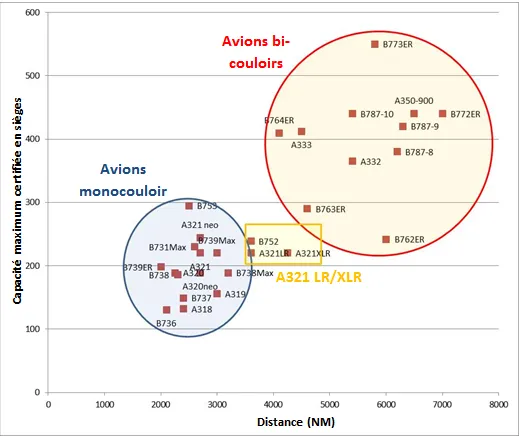
The Airbus A321neo XLR is one of many versions offered for this highly adaptable aircraft
The significant technological advance of the engines fitted to the neo family allows Airbus, on the one hand, to improve the range of the family’s aircraft considerably without any major change to the wing or fuselage and, on the other, to push the concept of versatility further on the Airbus A321neo thanks to the following three developments:
- Greater fuel capacity, with the option of a possible third ACT (additional centre tank)
- New combinations of certified weights, including higher maximum structural take-off weights (from 80 tonnes for aircraft operating short flights up to 101 tonnes). However, the operating empty weight (OEW) of the neo, i.e. without usable fuel or payload, is slightly higher
- A higher maximum certified passenger seat capacity, to meet the expectations of low-cost airlines in particular. This densified capacity is, however, achieved at the expense of part of the space available for galleys (ovens, trolleys, etc.)
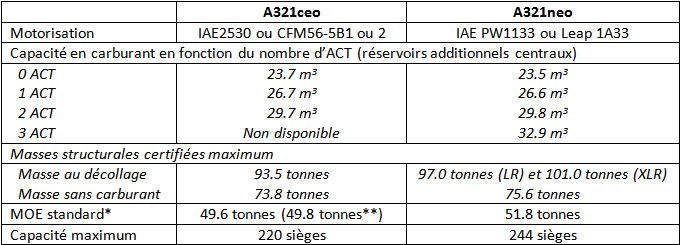
**: Aircraft with sharklets
Source: Airbus A321 Airport Planning Manual
The Airbus A321neo XLR is suited to developing long-haul routes with limited traffic
In its heaviest version, the Airbus A321neo XLR fitted with 3 ACTs can carry 220 passengers with 15 kg of checked baggage over a distance of around 4,200 NM (some 700 NM more than the LR version) – assuming standard fuel reserves – compared with almost 2,800 NM for the Airbus A321ceo fitted with sharklets and two ACTs.
Over such distances, the Airbus A321neo offers real opportunities to open up new long-haul routes whose traffic potential does not economically justify operating wide-body aircraft.
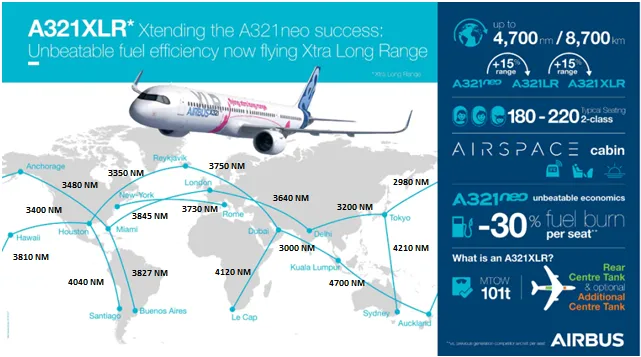
In its lighter versions (with a maximum take-off weight of 89 tonnes, for example), the Airbus A321neo without ACT can carry 244 passengers with 10 kg of checked baggage over 2,000 NM, and thus meets the needs of low-cost airlines with a low operating cost per seat offered.
For example, the hourly fuel burn per seat offered of the Airbus A321neo (244 seats) is 38% lower than that of the Boeing 757-200 (239 seats). The Boeing 737 MAX10 (230 seats) is the only single-aisle aircraft theoretically capable of approaching the A321neo’s performance.
In short, with the A321neo, Airbus seems to have achieved its goal of offering a truly versatile aircraft, suitable for operation by legacy or low-cost airlines on medium- and long-haul routes (with the LR and above all the XLR versions).
As the aircraft’s enviable order book at 30 June 2019 shows, the bet seems to have paid off: 2,493 aircraft remain to be delivered to 61 airlines (source: Airbus), around 250 of them for the XLR version alone, including 50 for American Airlines and 36 for Qantas.
Is the XLR version the missing piece that makes the highly versatile Airbus A321neo the “ideal” aircraft?
So is this aircraft the “ideal” aircraft? Perhaps not on every route, because of the limited hold volume when three ACTs are installed:
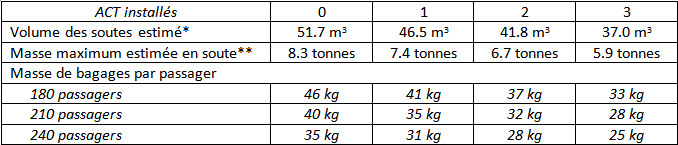
**: based on a baggage and cargo density of 160 kg/m3
On long-haul networks, the capacity to carry cargo in addition to checked baggage remains very low, even when the configuration is not very dense. On routes where the average baggage weight per passenger is high – such as between Europe and sub-Saharan Africa – A321neo operations can reasonably be considered only with a maximum of two ACTs, which slightly reduces the network that could be served.
The restriction caused by the reduced hold volume when 3 ACTs are installed therefore has an impact, although it remains marginal compared with the range of operating possibilities of the A321neo, as it only concerns the following routes:
- Those longer than 4,200 NM
- Those with very high passenger and/or cargo traffic
In conclusion, the A321neo in its XLR version should make it possible to open many new routes on which traffic flows are too small to justify the use of wide-body aircraft, including to airports from which no long-haul route is operated today.