

Changes in the international flight schedules of European airlines (continued)
2 July 2020 · 3 min read
Our previous finding of a tentative recovery in air traffic in June 2020 still holds, despite the gradual lifting of health and lockdown measures:
- As of 29 June 2020 (source: OAG, “Official Aviation Guide of the Airways”), 21% of European airlines’ international capacity[1] is being operated in the week of 30 June to 6 July 2020, compared with the flight schedules drawn up by the airlines before the Covid-19 pandemic (end of December 2019): three times as many flights as in the week of 2 to 8 June, when 93% of flights were cancelled.
Forecasts for early July also show a great deal of caution on the part of European airlines:
- The week of 7 to 13 July – today’s snapshot – shows a cancellation rate of 73% compared with the pre-Covid-19 reference. The reduction rate for the same period, but “photographed” last week, was significantly tighter at 56%.
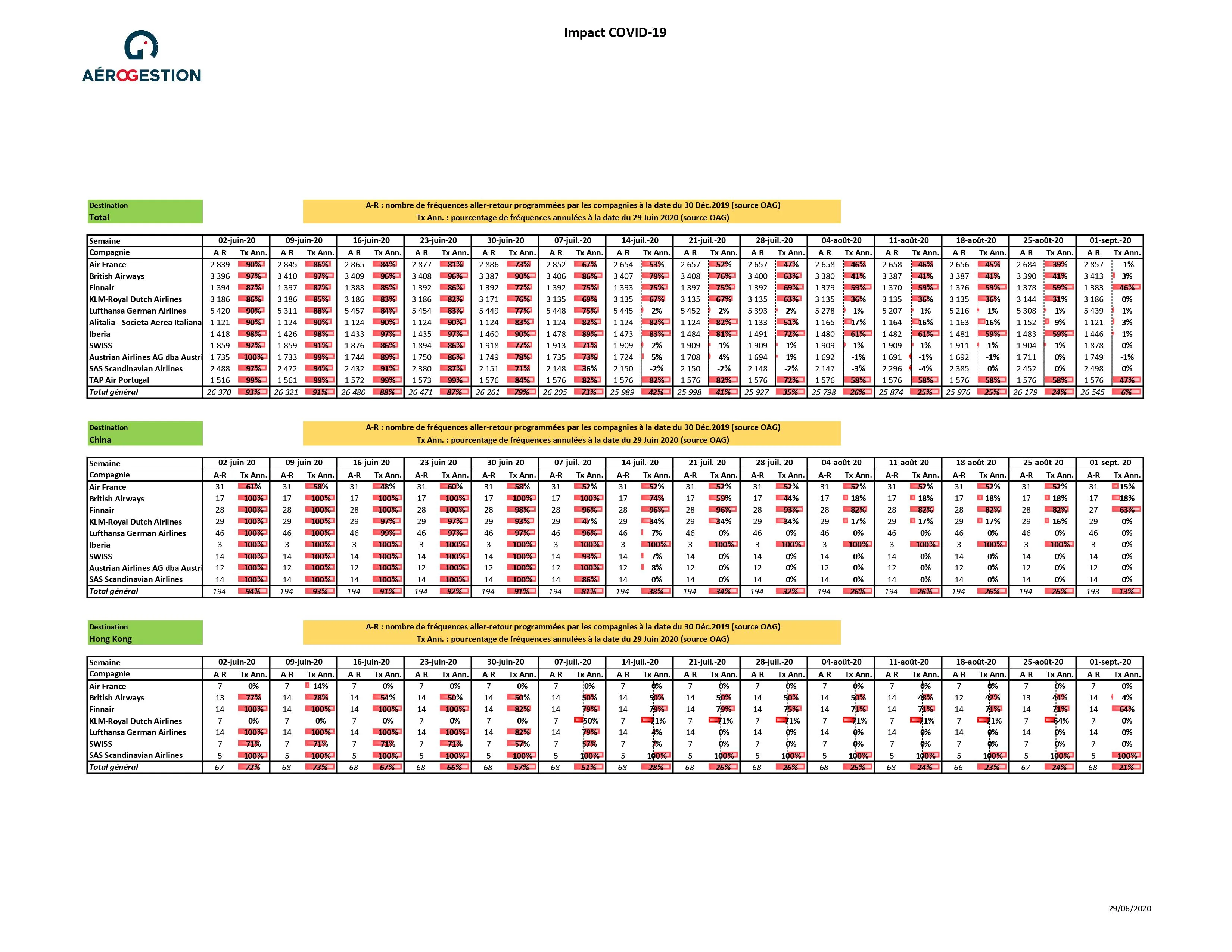
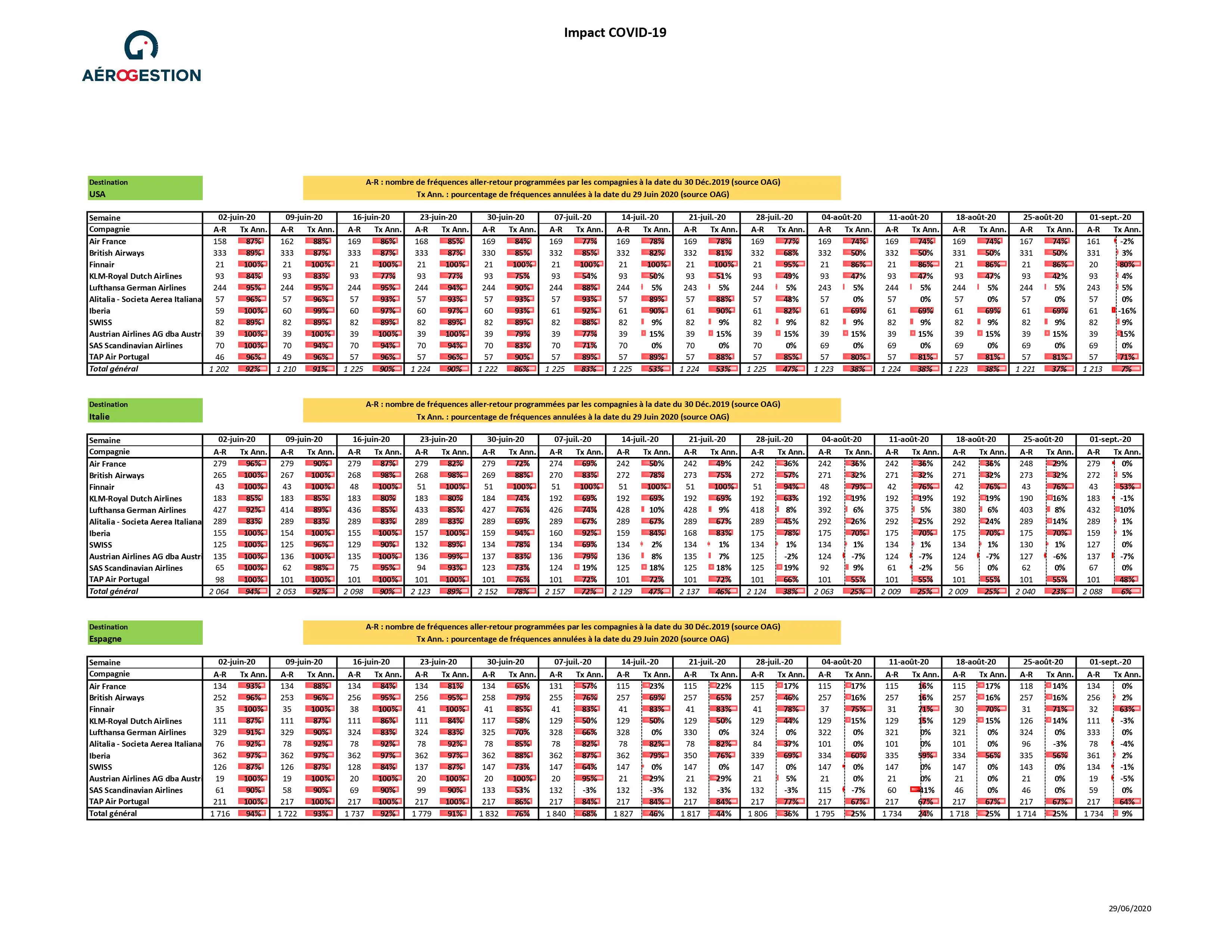
Europe is due to decide on Monday 29 June on reopening its external borders from 1st July (editor’s note: to be confirmed today depending on the EU decision). The vote is to approve a list of 14 countries, from which the United States, Russia and Turkey are already excluded. Chinese travellers could enter Europe: this is a partial opening, as the decision is subject to the principle of reciprocity, which is unlikely in the short term.
The recovery will be slow and gradual, and marked by profound change:
- IATA (International Air Transport Association) states that “the worst is yet to come for European skies”: in its latest estimate it put the loss at 23 billion euros for the European airline sector in 2020, with the traditionally profitable summer season hit hard.
The 120 billion in aid mobilised by governments (55% of it in loans) has made it possible to safeguard the very existence of the airlines; the counterpart, in the near future, is the necessary recapitalisation of the airlines (if conditions allow) or heavy restructuring to reduce the burden of debt.
- The first announcements by airlines concern a 20% to 30% reduction in their workforce: Lufthansa, for example, could cut up to 20,000 jobs, while Air France has announced 8,000 voluntary departures.
- Aircraft fleets will also be resized: until the Covid-19 pandemic, 35% to 40% of aircraft orders were intended to replace an ageing aircraft; the projection is now a replacement rate of 100%!
Uncertainty about the level of demand caused by the pandemic remains: the number of reported cases worldwide exceeded 10 million on 29 June, with more than a million new cases over the last six days and partial new lockdowns in China, the United States and Portugal.
A weaker or delayed recovery would further weaken an already depressed global airline sector and will profoundly change its structure in the coming months and beyond, particularly in France: this will be the subject of our next update.
[1] International capacity expressed in seats offered from the main airports or “hubs” of European airlines (11 airlines in our panel)