

Sectors suited to revenue management
3 October 2017 · 5 min read
Hotels, spas, golf courses, restaurants, cinemas, theme parks, car rental, car parks… Since airlines created it in the 1980s, revenue management (or yield management) has been winning over more and more sectors.
This real-time pricing makes it possible to optimise revenue significantly. For an airline, revenue management takes into account aircraft capacity, the different customer segments and expected demand. Put simply, the strategy aims to offer the right price to the right customer at the right time.
Aircraft capacity is thereby optimised, as is the cost price of each ticket, and the company’s profits grow.
So why isn’t this strategy applied everywhere? Which sectors are suited to it, and why?
We review the 5 criteria that are important, or even essential, for a company to implement a revenue management strategy.
1. Fixed or flexible capacity
The fixed capacity of a business is one of the main reasons for implementing a revenue management policy.
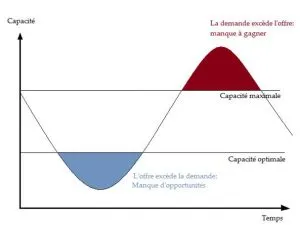
As the diagram above shows, three scenarios can arise for any company with fixed capacity:
- Demand exceeds capacity: this means lost revenue and a risk of declining quality (in the restaurant sector, for example, this would mean a long wait before getting a table).
- Demand is lower than capacity: this leads to lost revenue because resources are not optimised. For companies with high fixed costs, this situation is simply not sustainable in the long term.
- Demand matches capacity: revenue is optimised without any decline in service quality. Gains are maximised.
The goal of revenue management is to reach this last scenario. Since capacity cannot vary with demand, it is the prices set through revenue management that regulate demand so that it matches capacity as closely as possible. Revenue management thus smooths demand to rebalance off-peak and peak periods. This control over demand also helps guarantee a certain level of quality.
While capacity cannot change, it can nevertheless be flexible. Revenue management is applied, among others, in car rental, where the fleet can vary considerably with the seasons. Restaurants are a second example, where capacity, here the number of chairs and tables, can be adjusted within the same dining room by adding them or changing the table layout.
Revenue management therefore applies when a business’s capacity is fixed or, at least, capped at a certain level.
2. A perishable product
A revenue management policy is relevant when a product cannot be stored: it is lost if it is not sold. This is the case for service businesses, since services are by nature intangible.
When demand is low, revenue management rests on the principle that it is better to sell a perishable product at a lower price than usual than not to sell it at all. A service not sold on a given day is a dead loss for the company, as it cannot be sold twice the next day. In the hotel sector, when a room is not sold, the revenue that room could have generated is lost.
In the low season, revenue managers therefore readily offer attractive rates that will appeal to price-sensitive customers and may trigger a purchase that would not have been made at a higher price.
3. Fluctuating demand
Hourly, daily, weekly, monthly or half-yearly constraints lead people to behave similarly when buying, creating seasonal patterns of demand in many sectors.
A revenue management strategy becomes worthwhile when demand and customer profiles fluctuate from one period to another.
Across the tourism industry, business customers mostly travel from Tuesday to Thursday, while leisure customers depend mainly on weekends, school holidays and public holidays.
Depending on the period, seasonality makes it possible to:
- Determine customer volumes (peak / off-peak period)
- Know the customer profile (leisure / business customer)
Prices must be adapted to these fluctuations in demand: the stronger the demand, the higher the prices. Conversely, in the off-peak season, prices must be attractive in order to draw a wider range of customers and fill the available space as fully as possible.
Rates must also be adapted to the different customer profiles, since leisure customers are more price-sensitive than business customers, for example.
4. A product that can be sold in advance
Revenue management relies above all on forecasts. The further in advance a product can be sold, the more reliable the forecasts. Selling a product in advance also makes it possible to measure remaining capacity and adapt prices to it.
5. High fixed costs
Optimising resources through revenue management is decisive when a service company has high fixed costs: it is then essential to get the most out of the business to offset those heavy costs. This is the case, among others, in the hotel sector, where properties represent a significant investment and substantial annual costs.
As you will have gathered, revenue management is not reserved for air transport, although it is particularly well suited to that sector, given its very high fixed costs and strongly seasonal demand.
Océane BOCA, consultant at Aérogestion